
Webster Projected Versus Actual Release
A projected date is a calculation or scheduled point under the sentence. Actual release is the completed custody event. The two can differ because the court, Missouri DOC, Parole Board, institutional conduct process, or another holding agency may change what happens before the person leaves.
A Webster County pretrial detainee commonly has no computed release date. The next event may depend on bond, dismissal, plea, sentencing, a new court order, or another detainer. A detainer is a request from another authority to hold or receive the person. The jail can confirm processed custody, while Case.net can show the related order. Neither office should be asked to predict a future judicial choice.
Find a Webster Release Calculation
Start by identifying the custodian. County detention and state prison use different records. The Missouri DOC public welcome page says its search covers active offenders and excludes discharged offenders. It does not publicly name a projected-date field, and a person-level screen could not be verified during research because of CAPTCHA. Do not assume a label that the public interface has not confirmed.
- For a Webster County jail detainee, check Case.net for the controlling order and call the detention facility at 417-859-2247, press 2.
- For a state prisoner, search the Missouri DOC active-offender portal by first and last name. Compare aliases, DOC number, assignment, and timestamp.
- Ask the institutional caseworker or DOC records office what any date means. Separate minimum eligibility, conditional release, maximum expiration, and a Board-authorized date.
- Review the judgment and later orders. Consecutive sentences, amended credit, or a new order may change the computation.
- Check for a detainer or transfer. Exit from one institution may lead to another custodian.
- Confirm the actual event with the sending agency and, when applicable, the receiving agency.
The full Webster County released inmate search helps trace a person after the projected point if the person no longer appears with the first custodian.
Note: Identify the custodian before reading any date because county jail, state prison, and federal records answer different questions.
Missouri DOC Release Date Fields
The official DOC bulk layout documents “Sentence-I Minimum Release Date” and “Sentence Maximum Release Date.” The minimum is a calculated minimum on an active sentence. The maximum is the sentence’s maximum release or expiration date. These fields support sentence research, but neither is an exact prison-gate timestamp.
The DOC field definitions explain how the minimum and maximum concepts are stored.
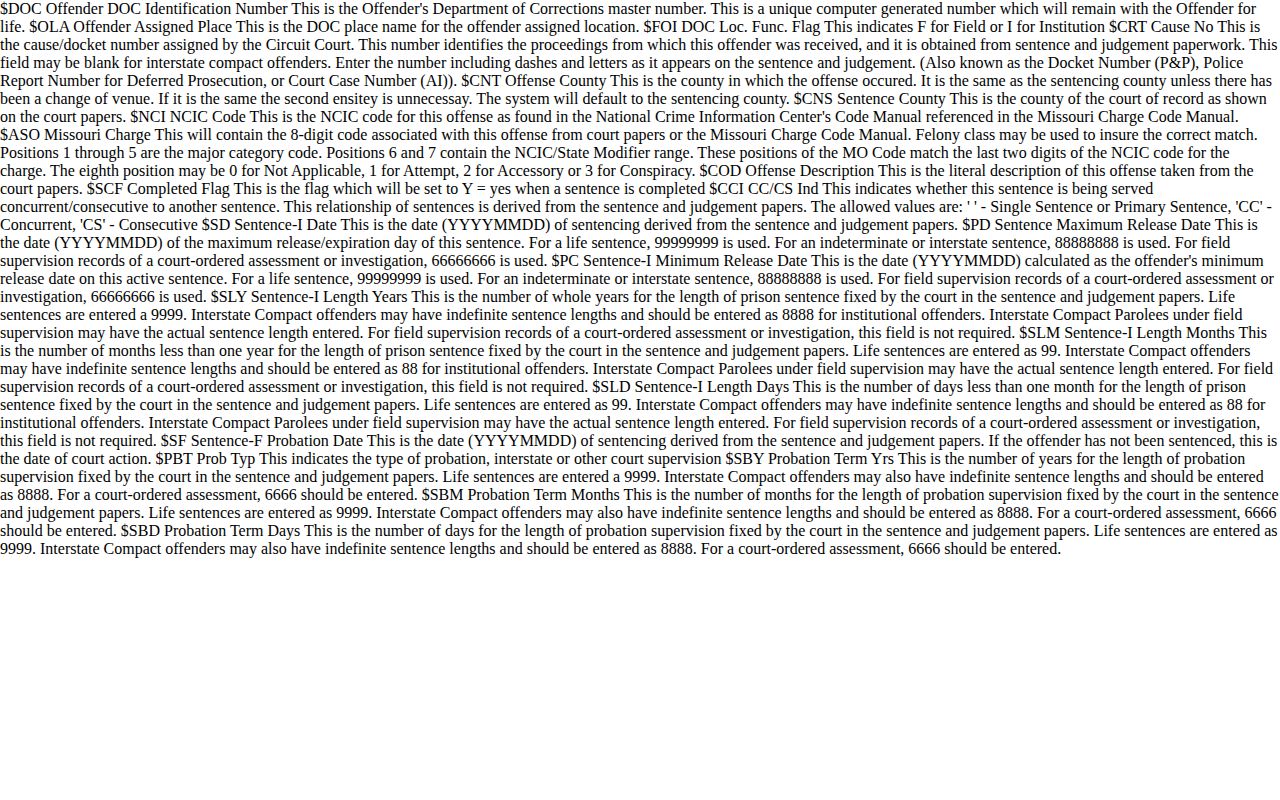
The definitions help interpret historical data without turning a calculation field into proof of actual release.
| Date or status | Meaning | Verification source |
|---|---|---|
| Minimum release date | Calculated minimum on an active sentence | DOC computation and sentence record |
| Conditional-release date | Potential start of a supervised sentence portion | DOC, Board, and §558.011 |
| Maximum release date | Maximum release or expiration point | DOC computation |
| Parole date | Board-authorized future or completed release event | Board result plus DOC status |
| Actual release | Completed exit from the named custodian | Sending agency’s release record |
Webster Minimum Terms Under §558.019
Missouri §558.019 sets minimum prison terms before eligibility for parole, conditional release, or another DOC early-release mechanism. For a dangerous felony as defined in §556.061, the statute generally requires 85 percent of the sentence, or until age 70 after at least 40 percent has been served, whichever comes first under the statutory terms.
The 85-percent rule is an eligibility minimum in context. It is not an automatic community-release date. Offense classification, sentence terms, prior commitments, age provisions, consecutive sentences, and Board action can all affect the calculation. For specified non-dangerous circumstances, the statute uses 40 percent for one prior DOC commitment, 50 percent for two, and 80 percent for three or more, subject to statutory details and age alternatives.
For minimum-term math, the statute treats life as 30 years and an aggregate sentence above 75 years as 75 years. Do not infer the governing percentage from a charge label alone. Read the judgment and ask DOC to interpret the computed record.
Eligibility is only permission for the next legal step. It does not compel the Board to grant parole, erase a detainer, or complete release processing. That is why a percentage calculation should be paired with the official sentence record and a current agency status rather than used as a stand-alone date.
Note: The 85-percent rule is an eligibility limit for qualifying state sentences, not a universal Webster County release formula.
Webster Conditional Release Can Change
Section 558.011 describes a prison term plus a conditional-release term for qualifying felony sentences. A term of nine years or less generally has a conditional-release component of one third. A term over nine through 15 years has three years, and a term over 15 years has five years. The prison component is the balance. The statute includes exceptions, including dangerous felonies and a fourth or later DOC remand.
Conditional release means a Board-ordered conditional discharge from prison followed by Probation and Parole supervision. It is not final discharge. After the required process for institutional rule violations, the Board may extend the date up to the full sentence. An older letter or calculation therefore may no longer control.
The official §558.011 text is shown in a successful matching capture.
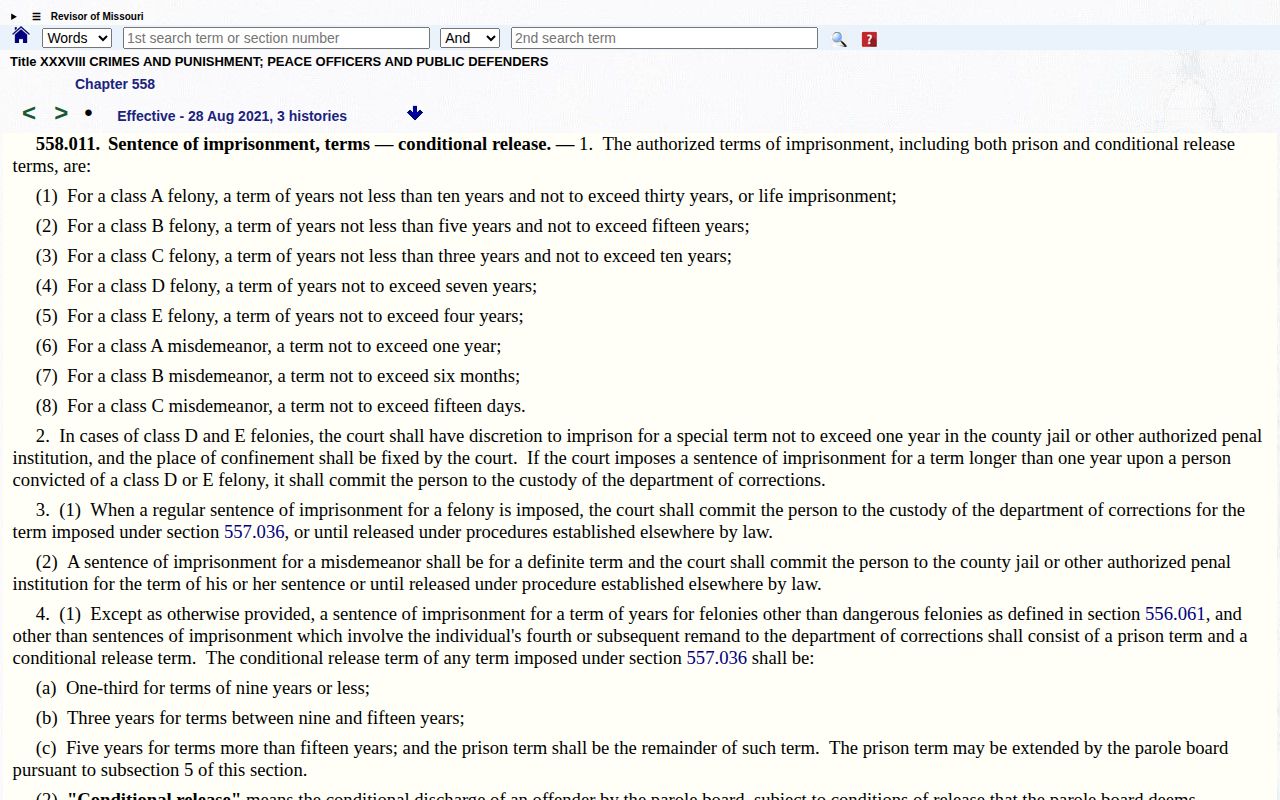
The statute’s layered prison and supervision terms explain why one projected release date cannot describe every stage of the sentence.
Parole Dates Require Board Action
Section 217.690 places parole authority with the Missouri Parole Board. The Board uses assessment and hearing procedures, but a hearing does not guarantee release. It may grant a future release date, deny release and set another hearing, defer for more information, or later revise an action under its authority.
Official guidance says decisions generally take eight to twelve weeks. No public person-level hearing calendar or searchable decision database was found during the official site sweep. For a specific matter, contact the Board at 573-751-8488 or DOC.MissouriParoleBoard@doc.mo.gov with the full name and DOC number where known.
A transfer between Missouri institutions is not parole. Likewise, a future Board date remains different from an actual exit. Confirm the result with DOC after the date arrives.
Institutional parole officers prepare assessments and release plans before a hearing or release. Field officers supervise a person after placement in the community. A plan can be necessary without being a promise. The completed Board action and later DOC assignment show whether planning became an authorized release.
Why Webster Release Dates Move
A date may shift for legal, disciplinary, or data reasons. The source used to verify the change should match the cause.
| Cause | Effect | Where to verify |
|---|---|---|
| Institutional rule violation | May extend conditional release after required process | DOC caseworker or Board record |
| Parole grant, denial, or deferment | Creates a date or later hearing | Board result and DOC |
| Consecutive sentences | Combines minimum eligibility terms under statutory rules | Judgment and DOC calculation |
| Dangerous-felony minimum | Restricts early-release eligibility | §558.019 and sentence record |
| Detainer | May send the person to another custodian | Sending and receiving agencies |
| Amended court order | Changes authority, sentence, or credit | Case.net and certified judgment |
| Data lag or recalculation | Portal may trail the current computation | Timestamp and direct DOC check |
| Transfer | Changes institution, not release status | DOC assignment history |
Note: A transfer changes the assigned institution without proving that the person returned to the community.
Webster Jail Dates Need Local Records
State-prison percentages should not be applied mechanically to a Webster County pretrial stay or short county sentence. No official county good-time formula, weekend-release rule, or holiday processing policy was found. Ask the jail and sentencing court how credit and the local sentence were calculated.
For the legal cause, search Case.net by name or case number. For the processed custody event, call the Webster County Detention Facility. A judge’s order may appear before staff finish release steps, and another hold can intervene. The exact release record may include time, disposition, destination, booking identifier, and case number if those fields are maintained and open.
Do not promise a pickup hour from a projected date. The jail publishes a 24-hour property pickup procedure, but that is not a 24-hour inmate discharge schedule. Call the jail before making travel plans.
A county sentence may also involve credit for time already served. The sentencing judgment and jail calculation should be read together. No official Webster formula was found that supports estimating the date from an arrest day alone, so direct records remain the sound route.
Compliance Credits Follow Webster Release
Missouri §217.703 concerns eligible people already on probation, parole, or conditional release. A full compliant calendar month earns 30 days against supervision. Credits pause during a violation report, absconder status, custody, or a revocation motion.
These are earned-compliance credits, not prison good time. They may advance final discharge from supervision, but they do not change the day a person left prison. Keeping those events separate prevents a later supervision discharge date from being mistaken for the original custody release.
Final discharge can cause a person to disappear from Missouri’s active-offender search. That absence should be tested against the historical Sunshine data, the court record, and DOC confirmation. A spelling mismatch or data lag can produce the same blank screen.
Note: Supervision credit can change final discharge while leaving the earlier prison release date unchanged.
Confirm a Webster Actual Release
Use the record closest to the event. The jail confirms a county custody exit. DOC confirms a prison assignment or field-supervision status. The Board confirms its decision. A receiving agency confirms whether a transfer became new custody.
MOVANS can send an SMS or email alert for supported Missouri custody and court events. Phone, PIN, and VINELink app notifications ended in May 2026. An alert can corroborate a change but cannot exclude another hold or supply a certified record. Current registration details are on the Webster VINELink Inmate Search page.
For a fully discharged DOC client, the public active search may be blank because Missouri excludes discharged offenders. Use the DOC Sunshine historical data and request an official record when exact completion matters.
Record the source and retrieval date for every figure. A nightly file field, a docket order, and a live custody call can reflect three different moments. When they conflict, ask the agency that owns the disputed field to explain it instead of choosing the earliest date.
Public Record Search
Sponsored Results