
Where Ozark Correctional Releases Go
An OCC departure must be classified by the event that changed custody. A transfer to another Missouri DOC institution changes the assigned place but does not end incarceration. A person released on parole or conditional release leaves the prison and enters community supervision while remaining under DOC authority. Final sentence expiration ends the active DOC relationship and produces discharge.
This distinction controls the search route. A parolee or person on conditional release may still appear in the active DOC search because legal custody and field supervision continue after the prison gate. A fully discharged person should be excluded from that active search. For the final category, the nightly historical data and an authoritative Sunshine request are the better tools.
| OCC event | Custody meaning | Best record |
|---|---|---|
| Transfer to another DOC prison | Still incarcerated | Active DOC assignment |
| Parole | Prison exit with field supervision | DOC active record and Board decision |
| Conditional release | Prison exit under statutory supervision | DOC and Probation and Parole record |
| Final discharge | DOC custody and supervision ended | Historical data or DOC response |
Confirm an Ozark Correctional Release
The Missouri DOC Offender Web Search is the first check for an active relationship. It accepts first and last name and says aliases are included. Read the page's data timestamp, compare identifiers with care, and distinguish an institution assignment from a field-supervision status.
- Search the Missouri DOC portal by the person's first and last name.
- Compare the DOC ID and other displayed details before choosing a match.
- Read the assigned place or supervision status without treating every active result as incarceration.
- For parole or conditional release, contact the assigned Probation and Parole officer or office.
- If there is no active result, search the DOC Sunshine historical file by DOC ID, name, and court identifiers.
- Request the authoritative release or discharge record from DOC when exact status matters.
Note: A parole or conditional-release result can remain active after the person has left the prison grounds.
Ozark Correctional Active and Discharge Records
Missouri's active portal includes people in prison and people on active probation or parole. That design is useful for someone who left OCC but remains under supervision. It is the reverse of a complete released-person archive because a person who completed every DOC obligation drops out of the public active system.
The DOC Sunshine Law and data page supplies the official historical fallback. DOC describes data about people who are or have been under supervision, reaching as early as 1974. The nightly FAK930 file may contain several charge rows for one lifelong DOC ID. It should be read with the official layout, field definitions, and location codes.
Historical data is a lead, not a certified release certificate. DOC warns about completeness, accuracy, currency, and self-reported information. Use the DOC ID with name, cause number, court case number, offense county, and completed flag. Then ask DOC for a direct response if the event must be established with authority.
Ozark Correctional Release Date Fields
The public person interface was not verified to display a field literally called a projected release date. Do not invent that label. The historical layout instead documents Sentence-I Minimum Release Date and Sentence Maximum Release Date. DOC defines the first as a calculated minimum on an active sentence and the second as the maximum release or expiration day.
| DOC item | What it means | What it does not prove |
|---|---|---|
| Minimum release date | Calculated minimum on an active sentence | Actual departure from OCC |
| Maximum release date | Maximum release or expiration day | That no earlier parole can occur |
| Assigned place | Current recorded institution or field unit | Complete assignment history |
| Completed flag | Historical completion indicator requiring context | A certified discharge record |
Special documented date values also need interpretation: `99999999` can mark life, `88888888` indeterminate or interstate cases, and `66666666` assessment in stated contexts. None is an actual gate-release timestamp.
Note: Minimum and maximum fields are sentence calculations, not verified dates of physical departure from Ozark Correctional Center.
Why an Ozark Correctional Release Date Changes
Missouri separates a minimum eligibility calculation, conditional-release structure, maximum sentence expiration, and actual Board-authorized release. Section 558.019 governs selected minimum terms and generally imposes an 85 percent minimum for dangerous felonies. Section 558.011 sets conditional-release terms and allows a conditional-release date to be extended after the required process for violations.
A person's timeline can also change through Parole Board action, institutional conduct, a new court order, a detainer, or another sentence. A Board hearing does not guarantee release, and an announced date can still be revised or rescinded under governing authority. A transfer changes location without establishing release at all.
The practical result is that a calculated field answers a different question from actual departure. Use the date as a planning marker, then confirm the event with OCC, DOC, the Board notice, and the assigned field officer. The Webster County projected-release guide explains those layers in more detail.
Ozark Correctional Records and Contact
OCC handles institution-specific questions, while central DOC records channels handle historical data and Sunshine requests. Call before traveling or sending records to confirm the current routing and any person-level limits.
929 Honor Camp Lane
Fordland, MO 65652
Phone: 417-767-4491
Fax: 417-767-2014
DOC Sunshine requests
OD.SunshineRequest@doc.mo.gov
For a person on parole or conditional release in Webster County, the current DOC directory points to District 10 at 2530 S. Campbell, Suite H, Springfield, MO 65807, 417-888-4203. District 10 serves Greene and Webster counties. An older guide listed a Marshfield reporting site that is not in the current directory, so call the current office rather than relying on the older address.
About Ozark Correctional Center Records
OCC is a minimum-security Missouri DOC institution physically located in Webster County. It is not operated by the Webster County Sheriff's Office, and it is not part of the county detention system. County jail records staff do not control state-prison admission, movement, parole, conditional release, or final discharge records.
DOC describes the Ozark Treatment Center as a 650-bed men's unit or program at OCC. That figure should not be presented as Webster County jail capacity or assumed to be a live OCC population count. Facility counts and operations can change. The official DOC page, not a county directory, is the right place to verify the current institution description.
Note: The 650-bed figure describes the treatment unit and must not be substituted for a current total OCC population.
How the Ozark Correctional Site Began
OCC has a distinctive Webster County history. The 65.4-acre, 57-building property began as an Air Force base constructed in January 1951. The Air Force used the site until 1961, and it reopened as a correctional center in January 1963. That history also makes the institution easy to confuse with other local facilities unless its present DOC role is stated clearly.
The Missouri DOC history of OCC records that transition.
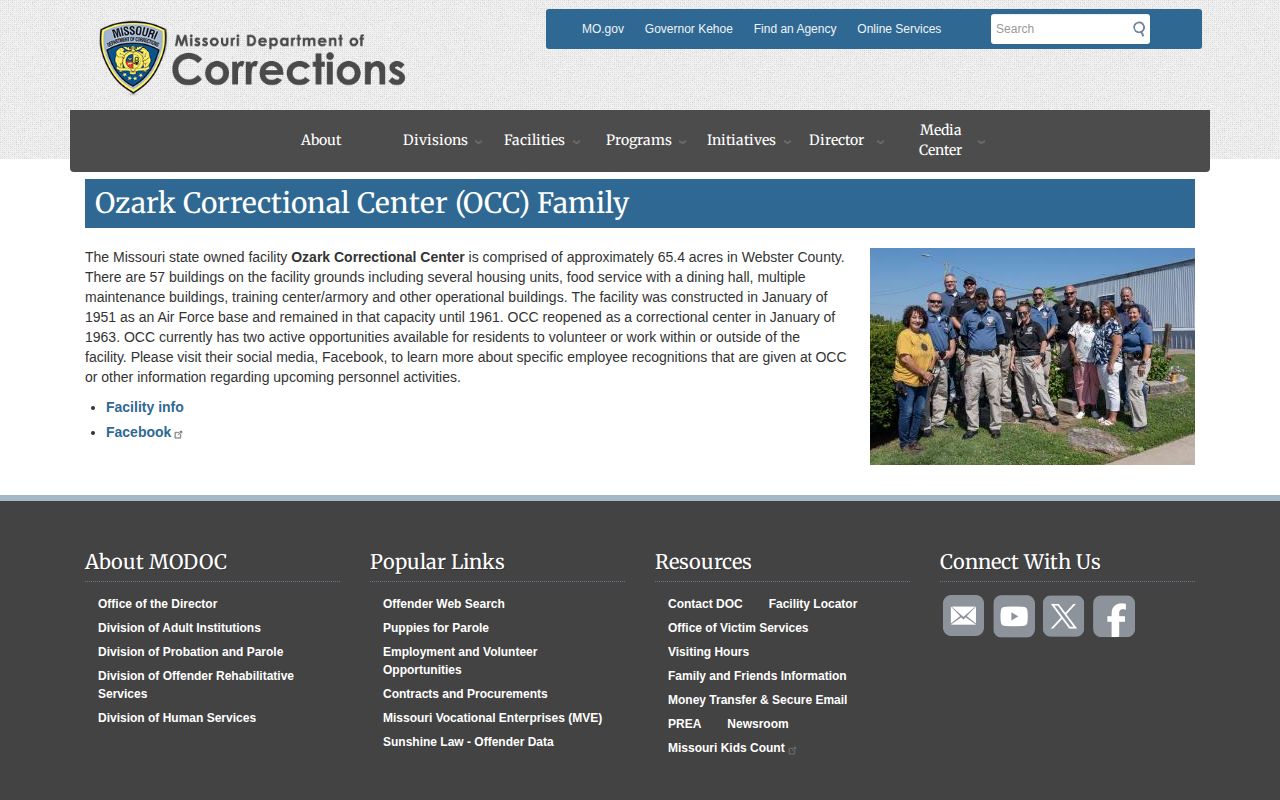
The historical setting is local context, while current release and transfer decisions remain governed by DOC records, sentence rules, and Parole Board action.
MOVANS Alerts for Ozark Correctional Releases
Current Missouri Victim Automated Notification System coverage includes DOC offenders and court events. A user can search one identified person and register for SMS or email notices. Missouri ended the old VINELink app and phone/PIN workflow for local jail notices in May 2026, so current portal instructions control.
A MOVANS alert can report a change supplied by DOC, but it is not a certified release record and does not exclude another hold. If an alert concerns release or transfer from OCC, compare it with the DOC status and contact the institution or assigned field office for the exact event, date, and destination. Federal prisoners require the BOP locator instead.
Note: MOVANS can flag a DOC event, while the institution or field office remains the authority for exact status.
Detainers After an Ozark Correctional Release
A planned release can be affected by another sentence, court order, warrant, or detainer. The calculated DOC date does not, by itself, establish that the person returned to the community. A receiving agency may take custody when Missouri prison authority ends or when DOC transfers the person under lawful process.
No official source identifies OCC as an ICE detention facility. ICE's Springfield check-in office serves Webster County, but that administrative office is not a jail. If another custodian receives the person, use both DOC's disposition and the receiving agency's current system. Do not infer transfer or freedom merely because the OCC assignment changes.
Limits of Ozark Correctional Release Searches
Identity and timing both create search limits. The active search includes aliases, yet similar names can still lead to a wrong match. Its timestamp can lag a real event. Absence can mean final discharge, a spelling mismatch, data delay, or that the person was never a Missouri DOC client. Historical rows may be incomplete and can repeat for separate charges.
Use a DOC ID whenever available. Compare the name with court and cause numbers, sentence county, and assignment information. Keep a clear line between an active supervision result and final discharge. For a full search and records route that also distinguishes county, court, federal, and immigration custody, use the Webster County released-inmate search hub.